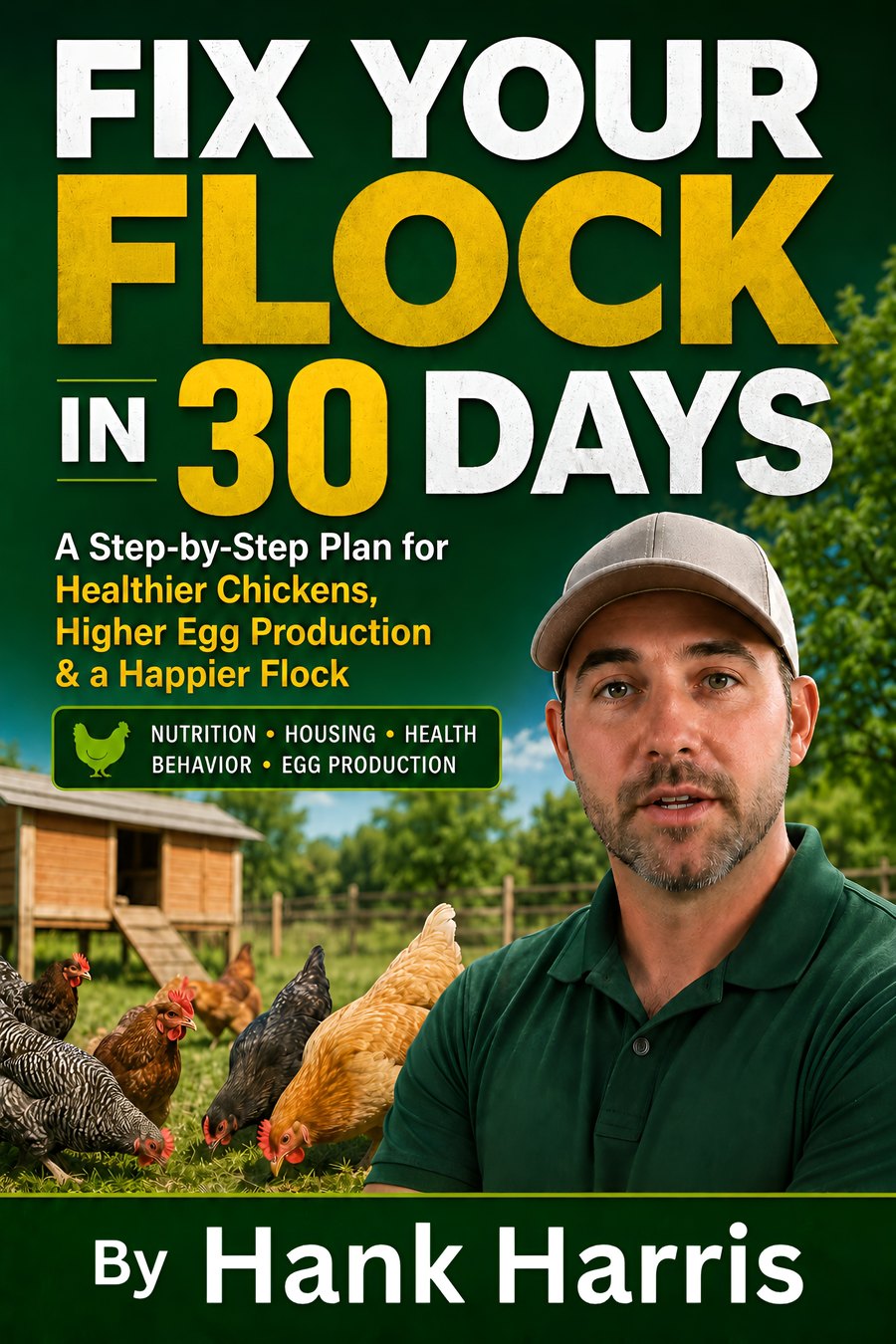
Breed choice. Feed formula. Coop ventilation. Parasite checks. Light hours. Flock stress. Get those six right in your first week, and the flock you've been buying $30 bags and bottles to fix starts fixing itself.
Skip the $800-a-year feed-aisle guessing game.
Do what lifelong keepers actually do — in 30 days, in plain English, one job per day.
Whether you're in Texas or Minnesota, Florida or Oregon — the plan adjusts to what your flock actually needs right now. You don't have to know what breeds you have. Day 1 walks you through assessing every bird in about ten minutes each. From there, the book gives you the exact 30-day plan for your situation.
The most powerful part of this book is not the feed recipe. It is the moment you see the feed-aisle math. The premium branding, the supplements, the tonics, the gadgets — that is what turns ordinary flock inputs into a recurring annual bill.
Fix Your Flock in 30 Days shows the keeper's version of the same logic: what to feed, when to feed it, what to skip, and when calling the vet actually makes sense.
Example math from the book's egg-math chapter: a 12-hen flock averaging 200 dozen eggs a year. Your flock size, local pricing, products, and legal label requirements may differ.
“The feed math chapter is genuinely the angriest I've been at a store shelf in years. I added up what I'd spent in twelve months — the premium bags, the electrolyte tonics, the herbal coop spray, the calcium boosters — and it came to $640 for a flock of twelve. The book's feed formula plus oyster shell on the side costs me about a third of that, and my hens are laying better than they ever did on the premium stuff. The shopping list in the back told me exactly what to order from the local mill. Book paid for itself before I'd even finished it.”

One Saturday in year three, I was standing in the run with a half-empty bag of "premium" feed, three hens that had quietly stopped laying, and another feed-store receipt in my pocket. I finally read the analysis tag on the back of the bag and realized I had been treating my flock like generic egg machines instead of specific birds with specific needs in a specific climate.
That was the turn. I spent years rebuilding my flock after I finally learned what was in those bags, why the winter slump wasn't "just what hens do," and which jobs a normal backyard keeper could handle without the supplements aisle deciding for them.
You might already know me from YouTube, where I share what I've learned about chickens, farming, and keeping a flock the practical way. This book is the 30-day version of what took me a decade to figure out: assess the birds, fix the feed, air out the coop, catch parasites early, manage the light, and stop letting the feed aisle make the plan for you.
It is not written like a textbook. It is written like a Saturday morning checklist for the keeper who wants the egg basket to finally stop embarrassing them.
It is buying by brand instead of diagnosis — then letting the feed aisle decide the plan for you.
“I bought it because my neighbor Steve gets a full basket every morning from a coop half the size of mine, and I was parking on the other side of the driveway out of embarrassment. I'm 51, I've been ‘trying’ with chickens for nine years, and I had no idea I was feeding a high-calcium layer ration to a mixed flock with three birds still months from laying. Day 1 saved me from another season of doing the exact opposite of what my flock needs. I'm a month in and the older hens are still catching up, but the egg basket looks like it belongs to a different house.”
The first seven days stop the guessing. Before you buy another bag, the book walks you through the seven decisions that determine whether the rest of the month works.
Clean water. Correct protein. Dry bedding. Real ventilation. The right light hours. Those are not glamorous, but they are the reason the same breed can lay completely differently across the street.
That is why the book dedicates a full part to the birds themselves: the breeds to avoid, the breeds that quietly pay, and the decision matrix that matches egg machines and dual-purpose breeds to your actual backyard. The feed aisle does not make that difference obvious. This book does.
“Two specific things from the rats-and-mites chapter. One: what I'd been calling ‘molt’ for two years was actually a red mite infestation, which means every dust bath I set up was treating the wrong problem — the mites were living in the roost ends, not on the birds. Two: the ragged feathers on my lowest-ranked hen weren't a parasite at all, they were a crowding signal pointing at a coop that was two birds over capacity. Moved the roosts, rehomed two hens, treated the roost ends properly. Feathers back. Eggs back. I felt like an idiot and a genius at the same time.”
“Honestly, on Day 4 I thought I'd wasted my $35. The feed chapter felt like something I already knew. Then I actually weighed what I was feeding and checked my coop light hours, and my hens had been getting nine hours of light and treat-diluted protein for six winters. Six winters. Fixed the ration, added a light on a timer for the morning gap, and by January I was getting eggs I'd always assumed were impossible until spring. First winter in eight years I didn't buy a single carton at the store.”
The complete PDF book is delivered after checkout. Read it on your phone, tablet or laptop — or keep the reference pages ready before you walk into the feed store, mix the ration, or set up the winter light.
“I'm 67, my husband passed three years ago, and the chickens were his thing — I had no idea where to even start. I needed a plan, not a YouTube rabbit hole. The 30-day sequence is what got me. One job a day, in order, with the reason explained. I did Foundation Week with my granddaughter helping me check every bird (two of the ‘hens’ Bill bought turned out to be a different breed than the receipt said, which explained a lot). The flock isn't a showpiece yet but I collected six eggs in one morning for the first time in my life last Sunday and I cried a little, honestly. Bill would have laughed at me.”
Verified reader reviews are included as provided for publication. Names, wording, and identifying details may be edited for privacy and clarity. Outcomes vary by breed, age, climate, housing, feed, predators, parasite load, and correct application of the plan.
Keep handing an extra $350+ a year to the supplements shelf that will not even tell you why your hens stopped laying last month.
Keep buying bags, bottles and seasonal panic forever.
Use one clear keeper's plan. Assess the birds, fix the feed, air out the coop, catch parasites early, manage the light, handle the stress and build the yearly calendar.
Once you learn your flock, nobody can sell you blind again.
By clicking you agree to our Terms of Service and Privacy Policy. This is educational poultry-keeping content. Always follow product labels, withdrawal periods, local regulations and safety instructions. By completing a purchase you consent to immediate delivery of digital content.